Have you heard of the Genographic Project?
http://www.msnbc.msn.com/id/10095659/
Advances in genetic research, good or bad, offer new paths of exploration for gaining insight into the history of humankind. Technology born in the rarified air of academic endeavor seems always destined to thread itself into the lives of proverbial "common man". You might find this info intriguing, or ... unnerving. Come back and share your thoughts.
Thursday, December 28, 2006

Thursday, November 30, 2006
Clock / Computer ???
By NICHOLAS PAPHITIS - Associated Press Writer
ATHENS, Greece(AP) Imagine tossing a top-notch laptop into the sea, leaving scientists from a foreign culture to scratch their heads over its corroded remains centuries later. A Roman shipmaster inadvertently did something just like it 2,000 years ago off southern Greece, experts said late Thursday.
They claim to have identified a handful of puzzling metal scraps found in the wreck as the earliest known mechanical computing device that pinpointed astronomical events.
Known as the Antikythera Mechanism _ from the island off which the Roman ship sank _ the assemblage of cogs and wheels looks like the innards of a very badly maintained grandfather clock.
Only the first clockwork devices appeared more than a thousand years later in western Europe.
"It was a pocket calculator of the time," said astronomer John Seiradakis.
Seiradakis, a professor of astronomy at the University of Thessaloniki, was among an international team including British, Greek and U.S. scientists who used specially developed x-ray scanning and imaging technology to analyze the corroded bronze, revealing hidden machinery and a form of written user's manual.
"We have used the latest technology available to understand this mechanism, yet the technological quality in this mechanism puts us to shame," said project leader Mike Edmunds, professor of astronomy at Cardiff University. "If the ancient Greeks made this, what else could they do?"
Ever since its discovery a century ago, the complex mechanism has baffled scientists.
Edmunds said the 82 surviving fragments, dated to between 140-100 B.C, contain over 30 gear wheels, and "are covered with astronomical, mathematical and mechanical inscriptions."
"It was a calendar of the moon and sun, it predicted the possibility of eclipses, it showed the position of the sun and moon in the zodiac, the phase of the moon, and we believe also it may have shown the position of some of the planets, possibly just Venus and Mercury," he said.
The box-shaped mechanism _ the size of office paper and operated with a hand-crank _ could predict an eclipse to a precise hour on a specific day.
"The design of the mechanism is very wonderful, making us realize how highly technological the ancient Greek civilization was. Much more so perhaps than we thought," Edmunds said.
The new study of the ancient device, with the aid of Hewlett Packard and the British x-ray equipment maker X-Tek, more than doubled the amount of the inscriptions readable on the mechanism.
"We will not yet be able to answer the question of what the mechanism was for, although now we know what the mechanism did," Edmunds said.
The first comparable devices known in the west were clockwork clocks developed during the Middle Ages.
The Antikythera device was probably made on the island of Rhodes, which had a long tradition in astronomy and applied mechanics.
The sunken ship, thought to have been carrying plunder from Roman-conquered Greece to Rome, is believed to have sailed from Rhodes.
It sank in the first century B.C.
The wreck was found in 1900 by Greek sponge-divers 50 meters (164 feet) deep and just off the small island of Antikythera, on what is still a busy trade route between southern mainland Greece and Crete.
A systematic search of the wreck revealed a group of bronze and badly weathered marble statues, as well as the Antikythera Mechanism, in what remained of its original wooden casing.
All the finds _ including wine jars, pottery, silver coins and plates _ are now at the National Archaeological Museum in Athens.
ATHENS, Greece(AP) Imagine tossing a top-notch laptop into the sea, leaving scientists from a foreign culture to scratch their heads over its corroded remains centuries later. A Roman shipmaster inadvertently did something just like it 2,000 years ago off southern Greece, experts said late Thursday.
They claim to have identified a handful of puzzling metal scraps found in the wreck as the earliest known mechanical computing device that pinpointed astronomical events.
Known as the Antikythera Mechanism _ from the island off which the Roman ship sank _ the assemblage of cogs and wheels looks like the innards of a very badly maintained grandfather clock.
Only the first clockwork devices appeared more than a thousand years later in western Europe.
"It was a pocket calculator of the time," said astronomer John Seiradakis.
Seiradakis, a professor of astronomy at the University of Thessaloniki, was among an international team including British, Greek and U.S. scientists who used specially developed x-ray scanning and imaging technology to analyze the corroded bronze, revealing hidden machinery and a form of written user's manual.
"We have used the latest technology available to understand this mechanism, yet the technological quality in this mechanism puts us to shame," said project leader Mike Edmunds, professor of astronomy at Cardiff University. "If the ancient Greeks made this, what else could they do?"
Ever since its discovery a century ago, the complex mechanism has baffled scientists.
Edmunds said the 82 surviving fragments, dated to between 140-100 B.C, contain over 30 gear wheels, and "are covered with astronomical, mathematical and mechanical inscriptions."
"It was a calendar of the moon and sun, it predicted the possibility of eclipses, it showed the position of the sun and moon in the zodiac, the phase of the moon, and we believe also it may have shown the position of some of the planets, possibly just Venus and Mercury," he said.
The box-shaped mechanism _ the size of office paper and operated with a hand-crank _ could predict an eclipse to a precise hour on a specific day.
"The design of the mechanism is very wonderful, making us realize how highly technological the ancient Greek civilization was. Much more so perhaps than we thought," Edmunds said.
The new study of the ancient device, with the aid of Hewlett Packard and the British x-ray equipment maker X-Tek, more than doubled the amount of the inscriptions readable on the mechanism.
"We will not yet be able to answer the question of what the mechanism was for, although now we know what the mechanism did," Edmunds said.
The first comparable devices known in the west were clockwork clocks developed during the Middle Ages.
The Antikythera device was probably made on the island of Rhodes, which had a long tradition in astronomy and applied mechanics.
The sunken ship, thought to have been carrying plunder from Roman-conquered Greece to Rome, is believed to have sailed from Rhodes.
It sank in the first century B.C.
The wreck was found in 1900 by Greek sponge-divers 50 meters (164 feet) deep and just off the small island of Antikythera, on what is still a busy trade route between southern mainland Greece and Crete.
A systematic search of the wreck revealed a group of bronze and badly weathered marble statues, as well as the Antikythera Mechanism, in what remained of its original wooden casing.
All the finds _ including wine jars, pottery, silver coins and plates _ are now at the National Archaeological Museum in Athens.
Tuesday, October 10, 2006
Weary Theory
September 8, 2006 ... Rochester in the News
Genetic Surprise Confirms Neglected 70-Year-Old Evolutionary Theory
...... Scientific American (September 8, 2006) ......
Wandering Fly Gene Supports New Model of Speciation
...... UPI (September 7, 2006) ......
Old, Unpopular Gene Theory Proved
CorrectMobile Genes Found to Pressure Species Formation
Biologists at the University of Rochester have discovered that an old and relatively unpopular theory about how a single species can split in two turns out to be accurate after all, and acting in nature.
The finding, reported in today's issue of Science, reveals that scientists must reassess the processes involved in the origin of species. The beginnings of speciation, suggests the paper, can be triggered by genes that change their locations in a genome.

JP Masly shows (drosophila)
flies he used
to confirm
old evolutionary theory
"In the 1930s there was speculation that parts of chromosomes that switch from one location to another might cause a species to split into two different species," says John Paul Masly, lead author of the paper and doctoral student at the University of Rochester. "Showing that it was more than an academic idea was difficult, and required a bit of luck. Other genetic causes of speciation are clearly documented in nature, and it wasn't until we had the ability to sequence whole genomes that we could even attempt to investigate the question."
Curiously, the hypothesis nearly died twice.
Theodosius Dobzhansky, a well-known evolutionary geneticist, studied fruit flies in the infant days of genetic research in 1930. He mapped out how it might be possible for sections of chromosomes to relocate themselves in a genome. Those mobile sections can cause sterility in inter-species hybrids, which can act as a speciation pressure.
In theory, the idea was sound, but scientists long debated whether it actually happened in nature. Eventually a competing theory involving the gradual accumulation of mutations was shown to occur in nature so often that geneticists largely dismissed the moving gene hypothesis.
"We knew going into this that it was a risky experiment," says Masly. "But we hoped we could pull it off."
Over the span of the six-year project, the prospects of bolstering the controversial evolutionary idea looked increasingly bleak.
Masly brought together two species of fruit fly—the workhorses of the genetics world—to see what genes were active when they were crossbred. One species, Drosophila melanogaster, had its genome already sequenced, making that part of the job much easier. The second species, Drosophila simulans, was still in the process of being sequenced, which meant much of the work had to be done by hand by Masly and his collaborators.
Masly knew that chromosome #4 on melanogaster held a gene that was somehow very important for fertility—information found earlier by Rochester biologist H. Allen Orr. Crossbreeding the flies proved tricky because a few million years of evolution separated the species, but after a few nudges the flies produced what Masly was looking for—a sterile male.
This is when Dobzhansky's 70-year-old hypothesis nearly died for good.
The reigning theory of speciation says that the genes causing hybrid sterility must have diverged slowly by normal evolutionary changes. To determine if this was true, Masly had only to look at chromosome #4 and find the gene on it that caused the hybrid sterility.
But there was no gene there.
"Something was all wrong. We couldn't find the gene and we were this close to giving up on the whole project"
"There was a great, 'Oh no,' moment," says Masly. "I'd been working on this for six years and it was starting to look like it was all for nothing. Something was all wrong. We couldn't find the gene and we were this close to giving up on the whole project."
But once again, insights from the past came into play. Masly and Orr, Masly's advisor and professor of biology at the University of Rochester, were talking one day when Orr suddenly recalled an off-hand comment from a scientist named Hermann J. Muller in a paper 60 years earlier. Muller speculated that perhaps since the sterility in the flies is so recessive—meaning it's almost completely non-functional—perhaps the gene in question has jumped clear off the chromosome.
"It had never occurred to us that the gene might have moved right off chromosome #4 in simulans," says Masly. As the simulans' genome was newly sequenced, Masly called a colleague, geneticist Corbin D. Jones, a co-author of the paper and Rochester graduate, who was studying the simulans genome.
Over the phone one day in the lab, Jones told Masly what his analysis turned up.
"You're not going to believe this, but you're right," said Jones. "It's not on the fourth chromosome. It's on the third."
"That was really exciting," says Masly. "It was completely unexpected and it made the cause of this hybrid's sterility very simple; the gene's on number four in one species and on number three in the other, so when you mate the two, every now and then you'll get a male with a combination that includes no gene at all. These guys are sterile because they completely lack a gene that's necessary for fertility."
The gene, called JYAlpha, is one of the same genes that is essential for sperm motility in the flies, as well as in humans and other mammals.
Masly's work shows a back door through which speciation can start. If the right genes jump around in the genome, a population can begin creating individuals that can't successfully mate with the general population. If other speciation pressures, like geographic isolation, are added to the mix, the pressure may be enough to split one species into two new species.
When asked if JYAlpha may be responsible for melanogaster and simulans' initial split a few million years ago, Masly replied, "That's lost to history."
Fortunately, the theory isn't.
This research was funded by the National Science Foundation, the Canadian Institutes of Health Research, and the National Institutes of Health.
Genetic Surprise Confirms Neglected 70-Year-Old Evolutionary Theory
...... Scientific American (September 8, 2006) ......
Wandering Fly Gene Supports New Model of Speciation
...... UPI (September 7, 2006) ......
Old, Unpopular Gene Theory Proved
CorrectMobile Genes Found to Pressure Species Formation
Biologists at the University of Rochester have discovered that an old and relatively unpopular theory about how a single species can split in two turns out to be accurate after all, and acting in nature.
The finding, reported in today's issue of Science, reveals that scientists must reassess the processes involved in the origin of species. The beginnings of speciation, suggests the paper, can be triggered by genes that change their locations in a genome.
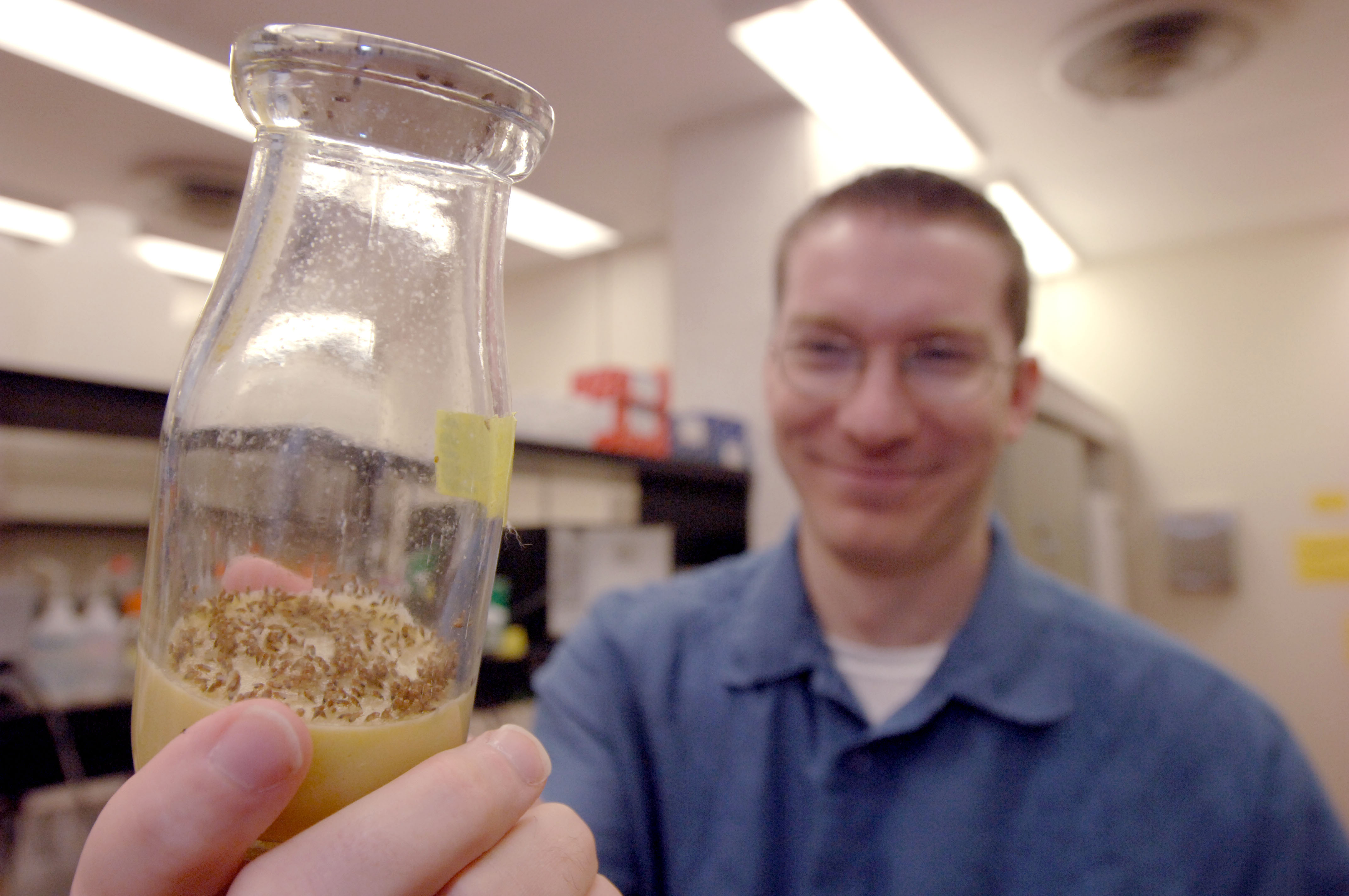
JP Masly shows (drosophila)
flies he used
to confirm
old evolutionary theory
"In the 1930s there was speculation that parts of chromosomes that switch from one location to another might cause a species to split into two different species," says John Paul Masly, lead author of the paper and doctoral student at the University of Rochester. "Showing that it was more than an academic idea was difficult, and required a bit of luck. Other genetic causes of speciation are clearly documented in nature, and it wasn't until we had the ability to sequence whole genomes that we could even attempt to investigate the question."
Curiously, the hypothesis nearly died twice.
Theodosius Dobzhansky, a well-known evolutionary geneticist, studied fruit flies in the infant days of genetic research in 1930. He mapped out how it might be possible for sections of chromosomes to relocate themselves in a genome. Those mobile sections can cause sterility in inter-species hybrids, which can act as a speciation pressure.
In theory, the idea was sound, but scientists long debated whether it actually happened in nature. Eventually a competing theory involving the gradual accumulation of mutations was shown to occur in nature so often that geneticists largely dismissed the moving gene hypothesis.
"We knew going into this that it was a risky experiment," says Masly. "But we hoped we could pull it off."
Over the span of the six-year project, the prospects of bolstering the controversial evolutionary idea looked increasingly bleak.
Masly brought together two species of fruit fly—the workhorses of the genetics world—to see what genes were active when they were crossbred. One species, Drosophila melanogaster, had its genome already sequenced, making that part of the job much easier. The second species, Drosophila simulans, was still in the process of being sequenced, which meant much of the work had to be done by hand by Masly and his collaborators.
Masly knew that chromosome #4 on melanogaster held a gene that was somehow very important for fertility—information found earlier by Rochester biologist H. Allen Orr. Crossbreeding the flies proved tricky because a few million years of evolution separated the species, but after a few nudges the flies produced what Masly was looking for—a sterile male.
This is when Dobzhansky's 70-year-old hypothesis nearly died for good.
The reigning theory of speciation says that the genes causing hybrid sterility must have diverged slowly by normal evolutionary changes. To determine if this was true, Masly had only to look at chromosome #4 and find the gene on it that caused the hybrid sterility.
But there was no gene there.
"Something was all wrong. We couldn't find the gene and we were this close to giving up on the whole project"
"There was a great, 'Oh no,' moment," says Masly. "I'd been working on this for six years and it was starting to look like it was all for nothing. Something was all wrong. We couldn't find the gene and we were this close to giving up on the whole project."
But once again, insights from the past came into play. Masly and Orr, Masly's advisor and professor of biology at the University of Rochester, were talking one day when Orr suddenly recalled an off-hand comment from a scientist named Hermann J. Muller in a paper 60 years earlier. Muller speculated that perhaps since the sterility in the flies is so recessive—meaning it's almost completely non-functional—perhaps the gene in question has jumped clear off the chromosome.
"It had never occurred to us that the gene might have moved right off chromosome #4 in simulans," says Masly. As the simulans' genome was newly sequenced, Masly called a colleague, geneticist Corbin D. Jones, a co-author of the paper and Rochester graduate, who was studying the simulans genome.
Over the phone one day in the lab, Jones told Masly what his analysis turned up.
"You're not going to believe this, but you're right," said Jones. "It's not on the fourth chromosome. It's on the third."
"That was really exciting," says Masly. "It was completely unexpected and it made the cause of this hybrid's sterility very simple; the gene's on number four in one species and on number three in the other, so when you mate the two, every now and then you'll get a male with a combination that includes no gene at all. These guys are sterile because they completely lack a gene that's necessary for fertility."
The gene, called JYAlpha, is one of the same genes that is essential for sperm motility in the flies, as well as in humans and other mammals.
Masly's work shows a back door through which speciation can start. If the right genes jump around in the genome, a population can begin creating individuals that can't successfully mate with the general population. If other speciation pressures, like geographic isolation, are added to the mix, the pressure may be enough to split one species into two new species.
When asked if JYAlpha may be responsible for melanogaster and simulans' initial split a few million years ago, Masly replied, "That's lost to history."
Fortunately, the theory isn't.
This research was funded by the National Science Foundation, the Canadian Institutes of Health Research, and the National Institutes of Health.
Wednesday, June 28, 2006
Searching Ancient Clues
SAO PAULO, Brazil(AP) A grouping of granite blocks along a grassy Amazon hilltop may be the vestiges of a centuries-old astronomical observatory _ a find archaeologists say indicates early rainforest inhabitants were more sophisticated than previously believed.
The 127 blocks, some as high as 9 feet tall, are spaced at regular intervals around the hill, like a crown 100 feet in diameter.
On the shortest day of the year _ Dec. 21 _ the shadow of one of the blocks, which is set at an angle, disappears.
"It is this block's alignment with the winter solstice that leads us to believe the site was once an astronomical observatory," said Mariana Petry Cabral, an archaeologist at the Amapa State Scientific and Technical Research Institute. "We may be also looking at the remnants of a sophisticated culture."
Scientists not involved in the discovery said it could prove valuable to understanding pre-Columbian societies in the Amazon.
"No one has ever described something like this before. This is an extremely novel find _ a one of a kind type of thing," said Michael Heckenberger of the University of Florida's Department of Anthropology.
"The traditional image is that some time thousands of years ago small groups of tropical forest horticulturists arrived in the area and they never changed _ (that) what we see today is just like it was 3,000 years ago," Heckenberger said. "This is one more thing that suggests that through the past thousands of years, societies have changed quite a lot."
The 127 blocks, some as high as 9 feet tall, are spaced at regular intervals around the hill, like a crown 100 feet in diameter.
On the shortest day of the year _ Dec. 21 _ the shadow of one of the blocks, which is set at an angle, disappears.
"It is this block's alignment with the winter solstice that leads us to believe the site was once an astronomical observatory," said Mariana Petry Cabral, an archaeologist at the Amapa State Scientific and Technical Research Institute. "We may be also looking at the remnants of a sophisticated culture."
Scientists not involved in the discovery said it could prove valuable to understanding pre-Columbian societies in the Amazon.
"No one has ever described something like this before. This is an extremely novel find _ a one of a kind type of thing," said Michael Heckenberger of the University of Florida's Department of Anthropology.
"The traditional image is that some time thousands of years ago small groups of tropical forest horticulturists arrived in the area and they never changed _ (that) what we see today is just like it was 3,000 years ago," Heckenberger said. "This is one more thing that suggests that through the past thousands of years, societies have changed quite a lot."
Thursday, June 01, 2006
Tuesday, May 02, 2006
Aboriginal "How-To"
“Philosophers have explained space. They have not explained time. It is the inexplicable raw material of everything. With it, all is possible; without it, nothing.
The supply of time is truly a daily miracle, an affair genuinely astonishing when one examines it. You wake up in the morning, and lo! your purse is magically filled with twenty-four hours of the unmanufactured tissue of the universe of your life! It is yours. It is the most precious of possessions. A highly singular commodity, showered upon you in a manner as singular as the commodity itself!
For remark! No one can take it from you. It is unstealable. And no one receives either more or less than you receive.”
[ quoting Arnold Bennett from "How to Live on Twenty-four Hours a Day" ]
The supply of time is truly a daily miracle, an affair genuinely astonishing when one examines it. You wake up in the morning, and lo! your purse is magically filled with twenty-four hours of the unmanufactured tissue of the universe of your life! It is yours. It is the most precious of possessions. A highly singular commodity, showered upon you in a manner as singular as the commodity itself!
For remark! No one can take it from you. It is unstealable. And no one receives either more or less than you receive.”
[ quoting Arnold Bennett from "How to Live on Twenty-four Hours a Day" ]
Tuesday, April 25, 2006
Private Poetry 1
The Moment by Kent Knowlton
I found it
I thought it was lost.
The relief
Was about the cost.
Still, fearing
Was about…the end of a memory.
I clutched it
I knew it was mine.
The touching
Was about the design.
Now, wondering
Was about…who owned it erstwhile.
I tested it
I imagined it gone stale.
The worry
Was about betrayal.
Next, resenting
Was about…the march of time.
I cleaned it
I cared for its hue.
The claiming
Was about its value.
Being surprised
Was about…its claim on me.
I put it up
I vowed to protect.
The resolution
Was about my neglect.
Sensing hope
Was about…infinity.
I lost it
I could not prevent.
The revelation
Was about my intent.
Gathering strength
Was about…its gift to me
I found it
I thought it was lost.
The relief
Was about the cost.
Still, fearing
Was about…the end of a memory.
I clutched it
I knew it was mine.
The touching
Was about the design.
Now, wondering
Was about…who owned it erstwhile.
I tested it
I imagined it gone stale.
The worry
Was about betrayal.
Next, resenting
Was about…the march of time.
I cleaned it
I cared for its hue.
The claiming
Was about its value.
Being surprised
Was about…its claim on me.
I put it up
I vowed to protect.
The resolution
Was about my neglect.
Sensing hope
Was about…infinity.
I lost it
I could not prevent.
The revelation
Was about my intent.
Gathering strength
Was about…its gift to me
Saturday, April 22, 2006
Launch
Here begins the Time Korner of my "Four Korners". My vision for this blog is to provide observation, inquiry, and discussion exclusively on the topics of world history, biblical history, archeology, and genealogy. These parameters will be understood to also allow material relating to military history, epics in government, cultural epics, myth / legend, human evolution and family ancestries. Look for photos and links to webpages I find exciting.